QA weekly focus: SVG

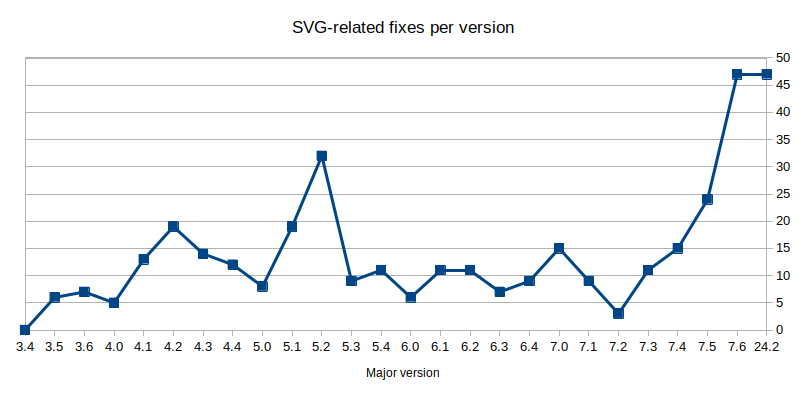
This week, we are kicking off a continuing “QA Weekly Focus” to attract attention to certain topics and areas. For this first week, let’s look into issues related to our SVG support. SVG stands for “Scalable Vector Graphics“, a widespread, open vector format and standard. It has become the most used vector format on the web, and it is for example used as the default format in Inkscape, the open source vector graphics editor. LibreOffice supports importing and exporting SVGs in various places, and these issues are tracked in 3 meta bugs: 88278: SVG import image filter (all modules) 111450: SVG fileSave filter (Draw/Impress) 156066: SVG filters In recent months, the SVG topic got a fair amount of attention, in particular thanks to Xisco Fauli’s work on the import filter (see illustration). Our friends at Inkscape have also recently voiced their interest in improving interoperability with LibreOffice (see Inkscape’s post on Mastodon). So let’s keep the momentum going, test how well SVG files are handled by LibreOffice, and review existing reports! They might need to be clarified, consolidated, or even closed because of all the recent improvements. The list of bugs to review is in this collaborative pad. You can
Read More

A community resolving issues collaboratively

Resolving issues and bringing improvements to LibreOffice is usually the result of team work – a team often made up of people who have never met each other! As a Free / Open Source project, LibreOffice has contributors in the space of translation, documentation, development, design… and Quality Assurance (QA) from around the globe. Some might have contributed for decades, others just reported a bug for the first time yesterday. Let’s have a look at three stories in which issues were identified, triaged and resolved in different ways, but always through a combined effort. Many hands make light work Take for example bug 153790 on Bugzilla. At least six contributors were involved in its resolution: Ruud reported an issue in sheet referencing in Calc formulas; Stéphane confirmed the issue, provided more precise steps and let others know that the issue is a regression; ady pinpointed more precisely in which version the issue started; raal bibisected the issue to a precise commit by Eike – the issue started in version 7.4; Eike provided a fix for version 7.5; Finally, Xisco created a unit test so the issue does not reappear in the future. Looking into an issue reveals another Here’s another

Read More

Investing in bug reports pays off

Document compatibility between office suites is a common concern for LibreOffice users. People take sample documents, expecting a pixel-perfect similarity with other office applications and rightly so. While we cover most aspects of formats outside the OpenDocument Format specification, LibreOffice’s native format, there are pieces that have not been implemented yet (for example smooth shadows, which have been implemented recently and will be available in LibreOffice 7.1). Of course we sometimes fail as well, like any other software producer. Microsoft’s “transitional” formats often include undocumented or obscure content that is hard for other office suites to parse. One enormous advantage of open source software is that you can talk more or less directly to the developers. All bug reports and enhancement requests are taken seriously and will receive immediate response unlike what happens when you complain about issues to companies without open development models. Unfortunately not everyone knows about this advantage so we thought it’s time to recall. The people doing quality assurance for LibreOffice is an ever-changing group of around 30 contributors. They analyse user reports tirelessly and always appreciate problem descriptions delivered in a clear and understandable way. In a recent article about LibreOffice appearing on dedoimedo.com, several

Read More